Mohsin Saeed Khan | Muhammad Tariq | Nimra Mudassir

In a time when Pakistan’s per‑capita water availability has plunged below survival thresholds and entire cities teeter on the brink of hydraulic collapse, Development Synergies International steps forward, not just as a consulting organization of thought leaders and technical experts, but architects of technologies, systems, resilience, sustainability, and systems innovation.
Our mission is not transactional, it is transformational
We are not merely responding to a water crisis. We are redefining how water is governed, valued, and preserved and beyond. From the deserts of Balochistan to the aquifers of Punjab, our work turns despair into design, data into dignity.
What Sets Development Synergies in Motion on Water Crisis
Integrated Intelligence: Policy acumen, AI analytics, local wisdom, delivering scalable, ground‑truth solutions.
Disruptive Advocacy: Challenging outdated paradigms; championing climate‑smart farming, equitable groundwater rights, and smart urban networks.
Proven Impact: National quantification plans, cross‑provincial dispute mediation, and IoT pilots that shift policy into practice.
Global Thinking, Local Stewardship: World‑class research bridged with community‑led design for solutions that are technically sound and socially just.
Our Promise in a Drying World
Water is not merely a resource; it is currency, equity, and survival. Ignored, it becomes our defining failure. Addressed intelligently, it unlocks a new era of stability, growth, and shared prosperity. DSI is building that future, where data‑driven forecasting, behavioural insight, and systems leadership converge to protect Pakistan’s most precious resource.
We invite governments, donors, innovators, and citizens to join our cause for local and global water conservation and an intergenerational responsibility and reshaping the entire architecture of water resilience.
As Pakistan crosses the threshold of 255 million people in 2025, the most critical question facing the country is no longer solely about food, energy, or even traditional security. It is water or, more precisely, its alarming scarcity.
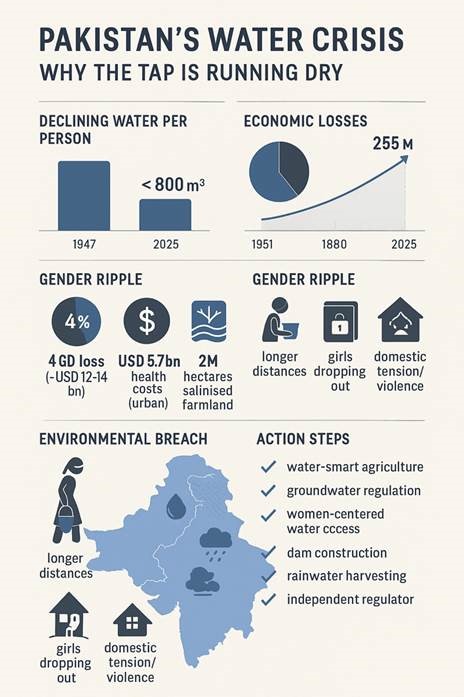 In 1947, per capita water availability in Pakistan stood
at 5,300 cubic metres annually, a level of abundance now rarely seen globally.
Fastforward to the present, and that figure has fallen below 800 cubic metres,
placing Pakistan among the world’s water scarce nations, as defined by the
United Nations [1,2]. This means that every fourth person or
63.75 million people in Pakistan does not have access to
potable water.
In 1947, per capita water availability in Pakistan stood
at 5,300 cubic metres annually, a level of abundance now rarely seen globally.
Fastforward to the present, and that figure has fallen below 800 cubic metres,
placing Pakistan among the world’s water scarce nations, as defined by the
United Nations [1,2]. This means that every fourth person or
63.75 million people in Pakistan does not have access to
potable water.
The principal causes are explosive population growth and chronic mismanagement.
From 1951 to 2025, Pakistan’s population has increased more than eightfold, while its renewable freshwater resources have remained virtually constant. This demographic explosion has resulted in one of the sharpest per capita water declines globally [3]. But this is not merely a numerical issue, it is a matter of survival, economic stability, and national cohesion.
Agriculture: Consuming 90 Percent and Wasting Most of It
Agriculture consumes over 90 percent of Pakistan’s freshwater, yet the efficiency of water use in the sector is among the lowest worldwide. Flood irrigation remains widespread, leading to vast wastage, while adoption of modern techniques such as drip or sprinkler irrigation is minimal [4]. Alarmingly, Pakistan yields only 0.13 kilograms of agricultural output per cubic metre of water, against a global average of 1.0 kilogram [3].
This inefficiency is no longer an agricultural issue alone; it is an existential threat to national development.
Urban Centres: Growing Populations and Collapsing Systems
Urbanisation, driven by rural migration and expanding middleclass demand, is stretching municipal water supplies beyond their limits. In Karachi, chronic water shortages have spawned a parallel, informal supply system controlled by tanker operators, resulting in exploitation and social unrest. In Lahore, excessive groundwater abstraction has caused aquifer levels to fall precipitously [5]. In many urban localities, piped water is available only a few hours daily, if at all.
Groundwater: The Failing Hidden Reservoir
Over 85 percent of drinking water and 60 percent of irrigation water in Pakistan originates from underground aquifers [2]. This critical but largely unregulated source is now under severe stress. Indiscriminate pumping, especially in Punjab and Sindh, has led to falling water tables, rising salinity, and chemical contamination, including arsenic infiltration. These developments pose significant health risks, particularly in periurban and rural areas.
Waterborne illnesses are responsible for nearly 40 percent of all reported diseases and onethird of deaths in Pakistan [6]. Despite this, access to safe drinking water remains elusive for millions.
Climate Change: Exacerbating the Crisis
Pakistan ranks among the ten most climatevulnerable countries globally [7]. The catastrophic floods of 2022 inundated onethird of the country and displaced 33 million people, laying bare the frailty of its water infrastructure. Compounding this, Pakistan’s water storage capacity is woefully inadequate, amounting to only 30 days, compared to over 200 days in neighbouring India [3].
Accelerating glacier melt and increasingly erratic rainfall patterns have made Pakistan’s dependence on the Indus Basin, a single river system supplying the majority of its surface water, an unsustainable gamble.
Water and National Security: A Brewing Conflict
The water crisis is no longer just a development challenge; it has evolved into a national security concern. Interprovincial disputes, especially among Punjab, Sindh, and Balochistan, are intensifying around perceived inequities in water allocation. Accusations of "water theft" have entered political discourse, fuelling division and undermining national cohesion.
Moreover, the Indus Waters Treaty is increasingly under strain amid rising geopolitical tensions with India, further complicating Pakistan’s external water security dynamics.
Economic Consequences: The Invisible Drain on GDP
The economic burden of water scarcity in Pakistan is vast. The World Bank estimates that waterrelated losses cost the country approximately 4 percent of its GDP annually, equivalent to around USD 12 to 14 billion [3]. These losses arise from diminished agricultural productivity, healthcare costs linked to waterborne diseases, and damage from floods and droughts.
In agriculture, poor irrigation and soil degradation from waterlogging and salinity affect more than 2 million hectares of land, undermining yields and farmer incomes [9].
Urban centres fare no better. Deficiencies in water supply and sanitation contribute to an annual economic loss of USD 5.7 billion, primarily through lost labour productivity, increased medical expenditures, and early mortality [4].
For a country already struggling with fiscal imbalances, mounting debt, and declining foreign direct investment, these hidden costs represent a grave impediment to national progress.
Technology-Based Solutions: Turning Crisis into Opportunity
While the challenges of water scarcity in Pakistan are immense, they also offer a chance to innovate. Technology-based solutions can enhance efficiency, accountability, and resilience in water management. These approaches, proven globally and regionally, must now be mainstreamed into Pakistan’s water governance frameworks.
Smart irrigation systems, such as solar-powered drip irrigation, are already being piloted in arid zones of Balochistan and Sindh. These systems reduce water use by up to 60 percent and simultaneously improve crop yields [10].
Remote sensing and satellite-based monitoring are increasingly used to track evapotranspiration and illegal abstractions. Pakistan’s collaboration with international agencies on using satellite imagery for crop mapping is a step in the right direction [11].
Digital water accounting tools like FAO’s WaPOR platform provide real-time data on water productivity at the basin and field levels. Countries across Africa and the Middle East have successfully integrated WaPOR into policymaking, a model Pakistan can replicate [12].
Internet of Things (IoT)-enabled groundwater sensors, used in Bangladesh and India, continuously monitor water quality and depth, alerting communities and authorities to contamination or depletion risks [13].
Mobile-based water quality testing linked to national health databases has helped countries like Kenya detect contamination in real time and mobilise health responses [14].
Furthermore, blockchain-based water rights frameworks implemented in Australia and piloted in Spain, offer new models of transparency in water allocation, especially for groundwater. In Pakistan’s context of interprovincial water disputes, such innovations may ensure fairer and tamper-proof resource distribution [15].
Pakistan’s technology deployment must be inclusive, gender-sensitive, and decentralised. Public–private partnerships, youth innovation hubs, and donor-supported pilot programmes can accelerate this transition.
The Cost of Inaction: A Catastrophe in Waiting
If no meaningful action is taken, Pakistan could become one of the world’s most waterstressed nations by 2040. Largescale displacement, agricultural collapse, and the uninhabitability of major urban centres are not dystopian projections, as they are foreseeable realities.
Nevertheless, hope endures. Pakistan’s youth, academic institutions, and civil society are increasingly vocal and active in calling for sustainable water management. What is now required is leadership, visionary, courageous, and committed, to treat water not merely as a utility but as the foundation of national survival.
Urgent Reforms: What Must Be Done
Pakistan’s National Water Policy, launched in 2018, was a significant milestone. However, its implementation has been uneven and largely symbolic at the provincial and district levels [8]. True reform demands a multipronged approach, including:
· Enabling use of technology to spatially determine alerts of where and what is required to tackle situation while developing community ownership and participation
· Substantial investment in water efficient agricultural systems
· Regulation and pricing mechanisms for groundwater abstraction
· Nationwide public awareness campaigns to promote behavioural change
· Rainwater harvesting schemes, especially in urbanised areas
· Strengthened transboundary water diplomacy
 Equally
critical is the depoliticisation of water governance. Independent regulatory
institutions must be empowered with the authority and resources to enforce
sustainable water policies. Without this, legislation will continue to be
undermined by vested interests and political expedience.
Equally
critical is the depoliticisation of water governance. Independent regulatory
institutions must be empowered with the authority and resources to enforce
sustainable water policies. Without this, legislation will continue to be
undermined by vested interests and political expedience.
References
1. Food and Agriculture Organization of the United Nations. AQUASTAT Country Profile – Pakistan [Internet]. Rome: FAO; 2023 [cited 2025 Jun 19]. Available from: https://www.fao.org/aquastat/statistics/query/index.html
2. Pakistan Council of Research in Water Resources. Annual Report 2023 [Internet]. Islamabad: PCRWR; 2023 [cited 2025 Jun 19]. Available from: https://www.pcrwr.gov.pk/publications
3. World Bank. Pakistan: Getting More from Water [Internet]. Washington, DC: World Bank; 2022 [cited 2025 Jun 19]. Available from: https://documents.worldbank.org/en/publication/documentsreports/documentdetail/099100303222210480/p1743120a867650d308a5504acdc58b134e
4. Asian Development Bank. Pakistan: Water Sector Diagnostic Report [Internet]. Manila: ADB; 2020 [cited 2025 Jun 19]. Available from: https://www.adb.org/documents/pakistanwatersectordiagnostic
5. WWF-Pakistan. Groundwater Depletion in Punjab: A Silent Crisis [Internet]. Lahore: WWF-Pakistan; 2022 [cited 2025 Jun 19]. Available from: https://www.wwfpak.org/our_work/freshwater/groundwater
6. United Nations Children’s Fund. WASH Sector Status Report Pakistan [Internet]. Islamabad: UNICEF; 2021 [cited 2025 Jun 19]. Available from: https://www.unicef.org/pakistan/reports/washsectorstatusreport2021
7. Germanwatch. Global Climate Risk Index 2022 [Internet]. Berlin: Germanwatch; 2022 [cited 2025 Jun 19]. Available from: https://www.germanwatch.org/en/cri
8. Ministry of Water Resources. National Water Policy [Internet]. Islamabad: Government of Pakistan; 2018 [cited 2025 Jun 19]. Available from: http://mowr.gov.pk/wpcontent/uploads/2018/04/NationalWaterPolicy20182.pdf
9. Food and Agriculture Organization of the United Nations. Land and Water Statistics: Pakistan Country Factsheet [Internet]. Rome: FAO; 2023 [cited 2025 Jun 19]. Available from: https://www.fao.org/landwater/statistics/en/
10. Food and Agriculture Organization of the United Nations. Solar-powered smart irrigation helps Pakistani farmers adapt to climate change [Internet]. FAO; 2022 [cited 2025 Jun 19]. Available from: https://www.fao.org/pakistan/news/detail-events/en/c/1510091
11. SUPARCO. Crop Mapping and Water Use Monitoring Using Satellite Imagery [Internet]. Pakistan Space and Upper Atmosphere Research Commission; 2023 [cited 2025 Jun 19]. Available from: https://www.suparco.gov.pk/services/agriculture/
12. FAO. WaPOR: Water Productivity through Open Access of Remotely sensed derived data [Internet]. Rome: FAO; 2023 [cited 2025 Jun 19]. Available from: https://wapor.apps.fao.org
13. WaterAid. Digital Water Management in South Asia [Internet]. WaterAid; 2023 [cited 2025 Jun 19]. Available from: https://www.wateraid.org/asia/blogs/smart-tech-for-water
14. UNICEF. Water Quality Monitoring in Rural Kenya Using Mobile Technology [Internet]. UNICEF; 2021 [cited 2025 Jun 19]. Available from: https://www.unicef.org/innovation/stories/water-testing-mobile-tech
15. World Bank. Blockchain for Water: Can Blockchain Increase Trust and Efficiency in Water Rights and Trading? [Internet]. World Bank Blogs; 2020 [cited 2025 Jun 19]. Available from: https://blogs.worldbank.org/water/blockchain-water-rights-and-trading